> ## Documentation Index
> Fetch the complete documentation index at: https://langchain-5e9cc07a-preview-opensw-1782332329-96d87c7.mintlify.site/llms.txt
> Use this file to discover all available pages before exploring further.
# Interrupts
Interrupts allow you to pause graph execution at specific points and wait for external input before continuing. This enables human-in-the-loop patterns where you need external input to proceed. When an interrupt is triggered, LangGraph saves the graph state using its [persistence](/oss/python/langgraph/persistence) layer and waits indefinitely until you resume execution.
Interrupts work by calling the `interrupt()` function at any point in your graph nodes. The function accepts any JSON-serializable value which is surfaced to the caller. When you're ready to continue, you resume execution by re-invoking the graph using `Command`, which then becomes the return value of the `interrupt()` call from inside the node.
Unlike static breakpoints (which pause before or after specific nodes), interrupts are **dynamic**: they can be placed anywhere in your code and can be conditional based on your application logic.
* **Checkpointing keeps your place:** the checkpointer writes the exact graph state so you can resume later, even when in an error state.
* **`thread_id` is your pointer:** set `config={"configurable": {"thread_id": ...}}` to tell the checkpointer which state to load.
* **Interrupt payloads surface via `stream.interrupts`:** when using [event streaming](/oss/python/langgraph/event-streaming) (`graph.stream_events(..., version="v3")`), the values you pass to `interrupt()` appear on `stream.interrupts`, and `stream.interrupted` is `True` when the run pauses for input.
The `thread_id` you choose is effectively your persistent cursor. Reusing it resumes the same checkpoint; using a new value starts a brand-new thread with an empty state.
## Pause using `interrupt`
The [`interrupt`](https://reference.langchain.com/python/langgraph/types/interrupt) function pauses graph execution and returns a value to the caller. When you call [`interrupt`](https://reference.langchain.com/python/langgraph/types/interrupt) within a node, LangGraph saves the current graph state and waits for you to resume execution with input.
To use [`interrupt`](https://reference.langchain.com/python/langgraph/types/interrupt), you need:
1. A **checkpointer** to persist the graph state (use a durable checkpointer in production)
2. A **thread ID** in your config so the runtime knows which state to resume from
3. To call `interrupt()` where you want to pause (payload must be JSON-serializable)
```python theme={null}
from langgraph.types import interrupt
def approval_node(state: State):
# Pause and ask for approval
approved = interrupt("Do you approve this action?")
# When you resume, Command(resume=...) returns that value here
return {"approved": approved}
```
When you call [`interrupt`](https://reference.langchain.com/python/langgraph/types/interrupt), here's what happens:
1. **Graph execution gets suspended** at the exact point where [`interrupt`](https://reference.langchain.com/python/langgraph/types/interrupt) is called
2. **State is saved** using the checkpointer so execution can be resumed later, In production, this should be a persistent checkpointer (e.g. backed by a database)
3. **Value is returned** to the caller on `stream.interrupts` when using [event streaming](/oss/python/langgraph/event-streaming) (`graph.stream_events(..., version="v3")`), or under `__interrupt__` with the default `invoke()` API; it can be any JSON-serializable value (string, object, array, etc.)
4. **Graph waits indefinitely** until you resume execution with a response
5. **Response is passed back** into the node when you resume, becoming the return value of the `interrupt()` call
## Resuming interrupts
After an interrupt pauses execution, you resume the graph by invoking it again with a `Command` that contains the resume value. The resume value is passed back to the `interrupt` call, allowing the node to continue execution with the external input.
The recommended way to drive a graph that may interrupt is [event streaming](/oss/python/langgraph/event-streaming) — it surfaces interrupts via `stream.interrupts` and `stream.interrupted`, and exposes the final state through `stream.output`.
```python theme={null}
from langgraph.types import Command
# Initial run - hits the interrupt and pauses
# thread_id is the persistent pointer (stores a stable ID in production)
config = {"configurable": {"thread_id": "thread-1"}}
stream = graph.stream_events({"input": "data"}, config=config, version="v3")
# Drain the stream to drive the run; stream.output awaits the final state.
final = stream.output
# stream.interrupted is True when the run paused for human input, and
# stream.interrupts contains the payloads passed to interrupt().
if stream.interrupted:
print(stream.interrupts)
# > (Interrupt(value='Do you approve this action?'),)
# Resume with the human's response
# The resume payload becomes the return value of interrupt() inside the node
resumed = graph.stream_events(Command(resume=True), config=config, version="v3")
final = resumed.output
```
The default `graph.invoke(...)` API still works and surfaces interrupts under `result["__interrupt__"]`. Use it when you don't need streamed projections; otherwise prefer `graph.stream_events(..., version="v3")`.
**Key points about resuming:**
* You must use the **same thread ID** when resuming that was used when the interrupt occurred
* The value passed to `Command(resume=...)` becomes the return value of the [`interrupt`](https://reference.langchain.com/python/langgraph/types/interrupt) call
* The node restarts from the beginning of the node where the [`interrupt`](https://reference.langchain.com/python/langgraph/types/interrupt) was called when resumed, so any code before the [`interrupt`](https://reference.langchain.com/python/langgraph/types/interrupt) runs again
* You can pass any JSON-serializable value as the resume value
`Command(resume=...)` is the **only** `Command` pattern intended as input to `invoke()`/`stream()`/`stream_events()`. The other `Command` parameters (`update`, `goto`, `graph`) are designed for [returning from node functions](/oss/python/langgraph/graph-api#command). Do not pass `Command(update=...)` as input to continue multi-turn conversations—pass a plain input dict instead.
## Common patterns
The key thing that interrupts unlock is the ability to pause execution and wait for external input. This is useful for a variety of use cases, including:
* [Approval workflows](#approve-or-reject): Pause before executing critical actions (API calls, database changes, financial transactions)
* [Handling multiple interrupts](#handling-multiple-interrupts): Pair interrupt IDs with resume values when resuming multiple interrupts in a single invocation
* [Review and edit](#review-and-edit-state): Let humans review and modify LLM outputs or tool calls before continuing
* [Interrupting tool calls](#interrupts-in-tools): Pause before executing tool calls to review and edit the tool call before execution
* [Validating human input](#validating-human-input): Pause before proceeding to the next step to validate human input
### Stream with human-in-the-loop (HITL) interrupts
When building interactive agents with human-in-the-loop workflows, you can use [event streaming](/oss/python/langgraph/event-streaming) to consume message chunks and state snapshots concurrently while handling interrupts.
Use the typed projections returned by `graph.stream_events(..., version="v3")` in a loop until the run finishes:
* Stream AI responses token-by-token via `stream.messages`
* Observe per-step state snapshots via `stream.values`
* Detect interrupts via `stream.interrupted` and read their payloads from `stream.interrupts`
* Resume execution by calling `stream_events` again with `Command(resume=...)` and repeat until `stream.interrupted` is false
```python theme={null}
from langgraph.types import Command
stream_input: dict | Command = initial_input
while True:
stream = graph.stream_events(stream_input, config=config, version="v3")
# Stream LLM message chunks (including any in subgraphs) as they arrive.
for message in stream.messages:
for token in message.text:
display_streaming_content(token)
# After the run finishes (or pauses), check for interrupts and resume.
if not stream.interrupted:
final_state = stream.output
break
interrupt_info = stream.interrupts[0].value
user_response = get_user_input(interrupt_info)
stream_input = Command(resume=user_response)
```
* **`stream.messages`**: Chat-model output as content blocks; iterate each `message.text` for token deltas. For nested subgraphs, read message chunks from `stream.subgraphs[*].messages`.
* **`stream.values`**: Full state snapshots after each step
* **`stream.interrupted` / `stream.interrupts`**: After each run, check whether the graph paused; read payloads from `stream.interrupts`
* **`Command(resume=...)`**: Pass as the next `stream_events` input to resume; loop until the run completes without interrupting
### Handling multiple interrupts
When parallel branches interrupt simultaneously (for example, fan-out to multiple nodes that each call `interrupt()`), you may need to resume multiple interrupts in a single invocation.
When resuming multiple interrupts with a single invocation, map each interrupt ID to its resume value.
This ensures each response is paired with the correct interrupt at runtime.
```python theme={null}
from typing import Annotated, TypedDict
import operator
from langgraph.checkpoint.memory import InMemorySaver
from langgraph.graph import END, START, StateGraph
from langgraph.types import Command, interrupt
class State(TypedDict):
vals: Annotated[list[str], operator.add]
def node_a(state):
answer = interrupt("question_a")
return {"vals": [f"a:{answer}"]}
def node_b(state):
answer = interrupt("question_b")
return {"vals": [f"b:{answer}"]}
graph = (
StateGraph(State)
.add_node("a", node_a)
.add_node("b", node_b)
.add_edge(START, "a")
.add_edge(START, "b")
.add_edge("a", END)
.add_edge("b", END)
.compile(checkpointer=InMemorySaver())
)
config = {"configurable": {"thread_id": "1"}}
# Step 1: stream events to drive the run; both parallel nodes hit interrupt() and pause
stream = graph.stream_events({"vals": []}, config, version="v3")
_ = stream.output # drive the stream to completion
# stream.interrupts contains the pending Interrupt payloads
print(stream.interrupts)
# > (Interrupt(value='question_a', id='...'), Interrupt(value='question_b', id='...'))
# Step 2: resume all pending interrupts at once
resume_map = {
i.id: f"answer for {i.value}" for i in stream.interrupts
}
resumed = graph.stream_events(Command(resume=resume_map), config, version="v3")
print("Final state:", resumed.output)
# Final state: {'vals': ['a:answer for question_a', 'b:answer for question_b']}
```
### Approve or reject
One of the most common uses of interrupts is to pause before a critical action and ask for approval. For example, you might want to ask a human to approve an API call, a database change, or any other important decision.
```python theme={null}
from typing import Literal
from langgraph.types import interrupt, Command
def approval_node(state: State) -> Command[Literal["proceed", "cancel"]]:
# Pause execution; payload shows up on stream.interrupts (with stream_events) or result["__interrupt__"] (with invoke)
is_approved = interrupt({
"question": "Do you want to proceed with this action?",
"details": state["action_details"]
})
# Route based on the response
if is_approved:
return Command(goto="proceed") # Runs after the resume payload is provided
else:
return Command(goto="cancel")
```
When you resume the graph, pass `True` to approve or `False` to reject:
```python theme={null}
# To approve
graph.stream_events(Command(resume=True), config=config, version="v3").output
# To reject
graph.stream_events(Command(resume=False), config=config, version="v3").output
```
```python theme={null}
from typing import Literal, Optional, TypedDict
from langgraph.checkpoint.memory import InMemorySaver
from langgraph.graph import END, START, StateGraph
from langgraph.types import Command, interrupt
class ApprovalState(TypedDict):
action_details: str
status: Optional[Literal["pending", "approved", "rejected"]]
def approval_node(state: ApprovalState) -> Command[Literal["proceed", "cancel"]]:
# Expose details so the caller can render them in a UI
decision = interrupt(
{
"question": "Approve this action?",
"details": state["action_details"],
}
)
# Route to the appropriate node after resume
return Command(goto="proceed" if decision else "cancel")
def proceed_node(state: ApprovalState):
return {"status": "approved"}
def cancel_node(state: ApprovalState):
return {"status": "rejected"}
builder = StateGraph(ApprovalState)
builder.add_node("approval", approval_node)
builder.add_node("proceed", proceed_node)
builder.add_node("cancel", cancel_node)
builder.add_edge(START, "approval")
builder.add_edge("proceed", END)
builder.add_edge("cancel", END)
# Use a more durable checkpointer in production
checkpointer = InMemorySaver()
graph = builder.compile(checkpointer=checkpointer)
config = {"configurable": {"thread_id": "approval-123"}}
initial = graph.stream_events(
{"action_details": "Transfer $500", "status": "pending"},
config=config,
version="v3",
)
_ = initial.output # drive the stream to completion
print(initial.interrupts) # -> (Interrupt(value={'question': ..., 'details': ...}),)
# Resume with the decision; True routes to proceed, False to cancel
resumed = graph.stream_events(Command(resume=True), config=config, version="v3")
print(resumed.output["status"])
```
### Review and edit state
Sometimes you want to let a human review and edit part of the graph state before continuing. This is useful for correcting LLMs, adding missing information, or making adjustments.
```python theme={null}
from langgraph.types import interrupt
def review_node(state: State):
# Pause and show the current content for review (payload surfaces on stream.interrupts)
edited_content = interrupt({
"instruction": "Review and edit this content",
"content": state["generated_text"]
})
# Update the state with the edited version
return {"generated_text": edited_content}
```
When resuming, provide the edited content:
```python theme={null}
graph.stream_events(
Command(resume="The edited and improved text"), # Value becomes the return from interrupt()
config=config,
version="v3",
).output
```
```python theme={null}
from typing import TypedDict
from langgraph.checkpoint.memory import MemorySaver
from langgraph.graph import END, START, StateGraph
from langgraph.types import Command, interrupt
class ReviewState(TypedDict):
generated_text: str
def review_node(state: ReviewState):
# Ask a reviewer to edit the generated content
updated = interrupt(
{
"instruction": "Review and edit this content",
"content": state["generated_text"],
}
)
return {"generated_text": updated}
builder = StateGraph(ReviewState)
builder.add_node("review", review_node)
builder.add_edge(START, "review")
builder.add_edge("review", END)
checkpointer = MemorySaver()
graph = builder.compile(checkpointer=checkpointer)
config = {"configurable": {"thread_id": "review-42"}}
initial = graph.stream_events(
{"generated_text": "Initial draft"}, config=config, version="v3"
)
_ = initial.output # drive the stream to completion
print(initial.interrupts) # -> (Interrupt(value={'instruction': ..., 'content': ...}),)
# Resume with the edited text from the reviewer
final_state = graph.stream_events(
Command(resume="Improved draft after review"),
config=config,
version="v3",
)
print(final_state.output["generated_text"]) # -> "Improved draft after review"
```
### Interrupts in tools
You can also place interrupts directly inside tool functions. This makes the tool itself pause for approval whenever it's called, and allows for human review and editing of the tool call before it is executed.
First, define a tool that uses [`interrupt`](https://reference.langchain.com/python/langgraph/types/interrupt):
```python theme={null}
from langchain.tools import tool
from langgraph.types import interrupt
@tool
def send_email(to: str, subject: str, body: str):
"""Send an email to a recipient."""
# Pause before sending; payload surfaces on stream.interrupts when using event streaming
response = interrupt({
"action": "send_email",
"to": to,
"subject": subject,
"body": body,
"message": "Approve sending this email?"
})
if response.get("action") == "approve":
# Resume value can override inputs before executing
final_to = response.get("to", to)
final_subject = response.get("subject", subject)
final_body = response.get("body", body)
return f"Email sent to {final_to} with subject '{final_subject}'"
return "Email cancelled by user"
```
This approach is useful when you want the approval logic to live with the tool itself, making it reusable across different parts of your graph. The LLM can call the tool naturally, and the interrupt will pause execution whenever the tool is invoked, allowing you to approve, edit, or cancel the action.
```python theme={null}
import sqlite3
import operator
from typing import TypedDict, Annotated, Literal
from langchain.tools import tool
from langchain_anthropic import ChatAnthropic
from langgraph.checkpoint.sqlite import SqliteSaver
from langgraph.graph import StateGraph, START, END
from langgraph.types import Command, interrupt
from langchain.messages import AnyMessage, SystemMessage, ToolMessage
class AgentState(TypedDict):
messages: Annotated[list[AnyMessage], operator.add]
@tool
def send_email(to: str, subject: str, body: str):
"""Send an email to a recipient."""
# Pause before sending; payload surfaces on stream.interrupts when using event streaming
response = interrupt({
"action": "send_email",
"to": to,
"subject": subject,
"body": body,
"message": "Approve sending this email?",
})
if response.get("action") == "approve":
final_to = response.get("to", to)
final_subject = response.get("subject", subject)
final_body = response.get("body", body)
# Actually send the email (your implementation here)
print(f"[send_email] to={final_to} subject={final_subject} body={final_body}")
return f"Email sent to {final_to}"
return "Email cancelled by user"
model = ChatAnthropic(model="claude-sonnet-4-6").bind_tools([send_email])
tools_by_name = {"send_email": send_email}
def agent_node(state: AgentState):
# LLM may decide to call the tool; interrupt pauses before sending
result = model.invoke(state["messages"])
return {"messages": [result]}
def tool_node(state: AgentState):
"""Performs the tool call"""
result = []
for tool_call in state["messages"][-1].tool_calls:
tool = tools_by_name[tool_call["name"]]
observation = tool.invoke(tool_call["args"])
result.append(ToolMessage(content=observation, tool_call_id=tool_call["id"]))
return {"messages": result}
def should_continue(state: AgentState) -> Literal["tool_node", END]:
"""Decide if we should continue the loop or stop based upon whether the LLM made a tool call"""
messages = state["messages"]
last_message = messages[-1]
if last_message.tool_calls:
return "tool_node"
return END
builder = StateGraph(AgentState)
builder.add_node("agent", agent_node)
builder.add_node("tool_node", tool_node)
builder.add_edge(START, "agent")
builder.add_conditional_edges("agent", should_continue, ["tool_node", END]) # Routes to "tools" or END
builder.add_edge("tool_node", "agent") # Loop back after tools
checkpointer = SqliteSaver(
sqlite3.connect("tool-approval.db", check_same_thread=False)
)
graph = builder.compile(checkpointer=checkpointer)
config = {"configurable": {"thread_id": "email-workflow"}}
initial = graph.stream_events(
{
"messages": [
{"role": "user", "content": "Send an email to alice@example.com about the meeting"}
]
},
config=config,
version="v3",
)
initial.output # drive the stream to completion
print(initial.interrupts) # -> (Interrupt(value={'action': 'send_email', ...}),)
# Resume with approval and optionally edited arguments
resumed = graph.stream_events(
Command(resume={"action": "approve", "subject": "Updated subject"}),
config=config,
version="v3",
)
print(resumed.output["messages"][-1]) # -> Tool result returned by send_email
```
### Validating human input
Sometimes you need to validate input from humans and re-prompt if the value is invalid. The recommended approach is to call `interrupt()` **once per node invocation**, return from the node with the error message stored in state, and use a **conditional edge** to loop back to the node until a valid value is provided.
**Avoid `while True` + `interrupt()` loops inside a single node.** Because the node re-runs from the beginning on every resume (see [Rules of interrupts](#rules-of-interrupts)), a loop that calls `interrupt()` multiple times causes each resume to replay all previous iterations: the first resume replays 1 iteration, the second replays 2, and so on. The result is exponential re-execution of any code inside the loop body.
The correct pattern:
1. Store the re-prompt question in state (e.g. `pending_question`).
2. In the node, call `interrupt()` **exactly once**, passing the current question from state.
3. If the answer is invalid, return the updated `pending_question` so the next invocation re-prompts.
4. Use `add_conditional_edges` to route back to the node until a valid value is collected.
```python theme={null}
from typing import TypedDict
from langgraph.graph import END, START, StateGraph
from langgraph.types import interrupt
class FormState(TypedDict):
age: int | None
pending_question: str | None
def get_age_node(state: FormState):
question = state.get("pending_question") or "What is your age?"
answer = interrupt(question) # called exactly once per invocation
if isinstance(answer, int) and answer > 0:
return {"age": answer, "pending_question": None}
return {"pending_question": f"'{answer}' is not a valid age. Please enter a positive number."}
def route(state: FormState):
return END if state.get("age") is not None else "collect_age"
builder = StateGraph(FormState)
builder.add_node("collect_age", get_age_node)
builder.add_edge(START, "collect_age")
builder.add_conditional_edges("collect_age", route)
```
Each resume invokes `get_age_node` exactly once, runs the `interrupt()` call once, and exits. When the answer is invalid, the conditional edge loops back and the next interrupt re-prompts with the updated question. No code runs more than once per resume.
```python theme={null}
from typing import TypedDict
from langgraph.checkpoint.memory import InMemorySaver
from langgraph.graph import END, START, StateGraph
from langgraph.types import Command, interrupt
class FormState(TypedDict):
age: int | None
pending_question: str | None
def get_age_node(state: FormState):
question = state.get("pending_question") or "What is your age?"
answer = interrupt(question) # called exactly once per node invocation
print(f"I got {answer}") # runs exactly once per resume
if isinstance(answer, int) and answer > 0:
return {"age": answer, "pending_question": None}
return {"pending_question": f"'{answer}' is not a valid age. Please enter a positive number."}
def route(state: FormState):
# Loop back to collect_age until we have a valid age
return END if state.get("age") is not None else "collect_age"
builder = StateGraph(FormState)
builder.add_node("collect_age", get_age_node)
builder.add_edge(START, "collect_age")
builder.add_conditional_edges("collect_age", route)
checkpointer = InMemorySaver()
graph = builder.compile(checkpointer=checkpointer)
config = {"configurable": {"thread_id": "form-1"}}
first = graph.stream_events({"age": None, "pending_question": None}, config=config, version="v3")
_ = first.output # drive the stream to completion
print(first.interrupts) # -> (Interrupt(value='What is your age?', ...),)
# Provide invalid data; the node re-prompts via the conditional edge
retry = graph.stream_events(Command(resume="thirty"), config=config, version="v3")
_ = retry.output
print(retry.interrupts) # -> (Interrupt(value="'thirty' is not a valid age...", ...),)
# Provide valid data; route() returns END and the graph finishes
final = graph.stream_events(Command(resume=30), config=config, version="v3")
print(final.output["age"]) # -> 30
```
## Rules of interrupts
When you call [`interrupt`](https://reference.langchain.com/python/langgraph/types/interrupt) within a node, LangGraph suspends execution by raising an exception that signals the runtime to pause. This exception propagates up through the call stack and is caught by the runtime, which notifies the graph to save the current state and wait for external input.
When execution resumes (after you provide the requested input), the runtime restarts the entire node from the beginning—it does not resume from the exact line where [`interrupt`](https://reference.langchain.com/python/langgraph/types/interrupt) was called. This means any code that ran before the [`interrupt`](https://reference.langchain.com/python/langgraph/types/interrupt) will execute again. Because of this, there's a few important rules to follow when working with interrupts to ensure they behave as expected.
### Do not wrap `interrupt` calls in try/except
The way that [`interrupt`](https://reference.langchain.com/python/langgraph/types/interrupt) pauses execution at the point of the call is by throwing a special exception. If you wrap the [`interrupt`](https://reference.langchain.com/python/langgraph/types/interrupt) call in a try/except block, you will catch this exception and the interrupt will not be passed back to the graph.
* ✅ Separate [`interrupt`](https://reference.langchain.com/python/langgraph/types/interrupt) calls from error-prone code
* ✅ Use specific exception types in try/except blocks
```python Separating logic theme={null}
def node_a(state: State):
# ✅ Good: interrupting first, then handling
# error conditions separately
interrupt("What's your name?")
try:
fetch_data() # This can fail
except Exception as e:
print(e)
return state
```
```python Explicit exception handling theme={null}
def node_a(state: State):
# ✅ Good: catching specific exception types
# will not catch the interrupt exception
try:
name = interrupt("What's your name?")
fetch_data() # This can fail
except NetworkException as e:
print(e)
return state
```
* 🔴 Do not wrap [`interrupt`](https://reference.langchain.com/python/langgraph/types/interrupt) calls in bare try/except blocks
```python theme={null}
def node_a(state: State):
# ❌ Bad: wrapping interrupt in bare try/except
# will catch the interrupt exception
try:
interrupt("What's your name?")
except Exception as e:
print(e)
return state
```
### Do not reorder `interrupt` calls within a node
It's common to use multiple interrupts in a single node, however this can lead to unexpected behavior if not handled carefully.
When a node contains multiple interrupt calls, LangGraph keeps a list of resume values specific to the task executing the node. Whenever execution resumes, it starts at the beginning of the node. For each interrupt encountered, LangGraph checks if a matching value exists in the task's resume list. Matching is **strictly index-based**, so the order of interrupt calls within the node is important.
* ✅ Keep [`interrupt`](https://reference.langchain.com/python/langgraph/types/interrupt) calls consistent across node executions
```python theme={null}
def node_a(state: State):
# ✅ Good: interrupt calls happen in the same order every time
name = interrupt("What's your name?")
age = interrupt("What's your age?")
city = interrupt("What's your city?")
return {
"name": name,
"age": age,
"city": city
}
```
* 🔴 Do not conditionally skip [`interrupt`](https://reference.langchain.com/python/langgraph/types/interrupt) calls within a node
* 🔴 Do not loop [`interrupt`](https://reference.langchain.com/python/langgraph/types/interrupt) calls using logic that isn't deterministic across executions, including `while True` validation loops. Use a conditional edge instead (see [Validating human input](#validating-human-input))
```python Skipping interrupts theme={null}
def node_a(state: State):
# ❌ Bad: conditionally skipping interrupts changes the order
name = interrupt("What's your name?")
# On first run, this might skip the interrupt
# On resume, it might not skip it - causing index mismatch
if state.get("needs_age"):
age = interrupt("What's your age?")
city = interrupt("What's your city?")
return {"name": name, "city": city}
```
```python Looping interrupts theme={null}
def node_a(state: State):
# ❌ Bad: looping based on non-deterministic data
# The number of interrupts changes between executions
results = []
for item in state.get("dynamic_list", []): # List might change between runs
result = interrupt(f"Approve {item}?")
results.append(result)
return {"results": results}
```
### Do not return complex values in `interrupt` calls
Depending on which checkpointer is used, complex values may not be serializable (e.g. you can't serialize a function). To make your graphs adaptable to any deployment, it's best practice to only use values that can be reasonably serialized.
* ✅ Pass simple, JSON-serializable types to [`interrupt`](https://reference.langchain.com/python/langgraph/types/interrupt)
* ✅ Pass dictionaries/objects with simple values
```python Simple values theme={null}
def node_a(state: State):
# ✅ Good: passing simple types that are serializable
name = interrupt("What's your name?")
count = interrupt(42)
approved = interrupt(True)
return {"name": name, "count": count, "approved": approved}
```
```python Structured data theme={null}
def node_a(state: State):
# ✅ Good: passing dictionaries with simple values
response = interrupt({
"question": "Enter user details",
"fields": ["name", "email", "age"],
"current_values": state.get("user", {})
})
return {"user": response}
```
* 🔴 Do not pass functions, class instances, or other complex objects to [`interrupt`](https://reference.langchain.com/python/langgraph/types/interrupt)
```python Functions theme={null}
def validate_input(value):
return len(value) > 0
def node_a(state: State):
# ❌ Bad: passing a function to interrupt
# The function cannot be serialized
response = interrupt({
"question": "What's your name?",
"validator": validate_input # This will fail
})
return {"name": response}
```
```python Class instances theme={null}
class DataProcessor:
def __init__(self, config):
self.config = config
def node_a(state: State):
processor = DataProcessor({"mode": "strict"})
# ❌ Bad: passing a class instance to interrupt
# The instance cannot be serialized
response = interrupt({
"question": "Enter data to process",
"processor": processor # This will fail
})
return {"result": response}
```
### Side effects called before `interrupt` must be idempotent
Because interrupts work by re-running the nodes they were called from, side effects called before [`interrupt`](https://reference.langchain.com/python/langgraph/types/interrupt) should (ideally) be idempotent. For context, idempotency means that the same operation can be applied multiple times without changing the result beyond the initial execution.
As an example, you might have an API call to update a record inside of a node. If [`interrupt`](https://reference.langchain.com/python/langgraph/types/interrupt) is called after that call is made, it will be re-run multiple times when the node is resumed, potentially overwriting the initial update or creating duplicate records.
* ✅ Use idempotent operations before [`interrupt`](https://reference.langchain.com/python/langgraph/types/interrupt)
* ✅ Place side effects after [`interrupt`](https://reference.langchain.com/python/langgraph/types/interrupt) calls
* ✅ Separate side effects into separate nodes when possible
```python Idempotent operations theme={null}
def node_a(state: State):
# ✅ Good: using upsert operation which is idempotent
# Running this multiple times will have the same result
db.upsert_user(
user_id=state["user_id"],
status="pending_approval"
)
approved = interrupt("Approve this change?")
return {"approved": approved}
```
```python Side effects after interrupt theme={null}
def node_a(state: State):
# ✅ Good: placing side effect after the interrupt
# This ensures it only runs once after approval is received
approved = interrupt("Approve this change?")
if approved:
db.create_audit_log(
user_id=state["user_id"],
action="approved"
)
return {"approved": approved}
```
```python Separating into different nodes theme={null}
def approval_node(state: State):
# ✅ Good: only handling the interrupt in this node
approved = interrupt("Approve this change?")
return {"approved": approved}
def notification_node(state: State):
# ✅ Good: side effect happens in a separate node
# This runs after approval, so it only executes once
if (state.approved):
send_notification(
user_id=state["user_id"],
status="approved"
)
return state
```
* 🔴 Do not perform non-idempotent operations before [`interrupt`](https://reference.langchain.com/python/langgraph/types/interrupt)
* 🔴 Do not create new records without checking if they exist
```python Creating records theme={null}
def node_a(state: State):
# ❌ Bad: creating a new record before interrupt
# This will create duplicate records on each resume
audit_id = db.create_audit_log({
"user_id": state["user_id"],
"action": "pending_approval",
"timestamp": datetime.now()
})
approved = interrupt("Approve this change?")
return {"approved": approved, "audit_id": audit_id}
```
```python Appending to lists theme={null}
def node_a(state: State):
# ❌ Bad: appending to a list before interrupt
# This will add duplicate entries on each resume
db.append_to_history(state["user_id"], "approval_requested")
approved = interrupt("Approve this change?")
return {"approved": approved}
```
## Using with subgraphs called as functions
When invoking a subgraph within a node, the parent graph will resume execution from the **beginning of the node** where the subgraph was invoked and the [`interrupt`](https://reference.langchain.com/python/langgraph/types/interrupt) was triggered. Similarly, the **subgraph** will also resume from the beginning of the node where [`interrupt`](https://reference.langchain.com/python/langgraph/types/interrupt) was called.
```python theme={null}
def node_in_parent_graph(state: State):
some_code() # <-- This will re-execute when resumed
# Invoke a subgraph as a function.
# The subgraph contains an `interrupt` call.
subgraph_result = subgraph.invoke(some_input)
# ...
def node_in_subgraph(state: State):
some_other_code() # <-- This will also re-execute when resumed
result = interrupt("What's your name?")
# ...
```
## Debugging with interrupts
To debug and test a graph, you can use static interrupts as breakpoints to step through the graph execution one node at a time. Static interrupts are triggered at defined points either before or after a node executes. You can set these by specifying `interrupt_before` and `interrupt_after` when compiling the graph.
Static interrupts are **not** recommended for human-in-the-loop workflows. Use the [`interrupt`](https://reference.langchain.com/python/langgraph/types/interrupt) function instead.
```python theme={null}
graph = builder.compile(
interrupt_before=["node_a"], # [!code highlight]
interrupt_after=["node_b", "node_c"], # [!code highlight]
checkpointer=checkpointer,
)
# Pass a thread ID to the graph
config = {
"configurable": {
"thread_id": "some_thread"
}
}
# Run the graph until the breakpoint
graph.invoke(inputs, config=config) # [!code highlight]
# Resume the graph
graph.invoke(None, config=config) # [!code highlight]
```
1. The breakpoints are set during `compile` time.
2. `interrupt_before` specifies the nodes where execution should pause before the node is executed.
3. `interrupt_after` specifies the nodes where execution should pause after the node is executed.
4. A checkpointer is required to enable breakpoints.
5. The graph is run until the first breakpoint is hit.
6. The graph is resumed by passing in `None` for the input. This will run the graph until the next breakpoint is hit.
```python theme={null}
config = {
"configurable": {
"thread_id": "some_thread"
}
}
# Run the graph until the breakpoint
graph.invoke(
inputs,
interrupt_before=["node_a"], # [!code highlight]
interrupt_after=["node_b", "node_c"], # [!code highlight]
config=config,
)
# Resume the graph
graph.invoke(None, config=config) # [!code highlight]
```
1. `graph.invoke` is called with the `interrupt_before` and `interrupt_after` parameters. This is a run-time configuration and can be changed for every invocation.
2. `interrupt_before` specifies the nodes where execution should pause before the node is executed.
3. `interrupt_after` specifies the nodes where execution should pause after the node is executed.
4. The graph is run until the first breakpoint is hit.
5. The graph is resumed by passing in `None` for the input. This will run the graph until the next breakpoint is hit.
To debug your interrupts, use [LangSmith](/langsmith/observability).
### Using LangSmith Studio
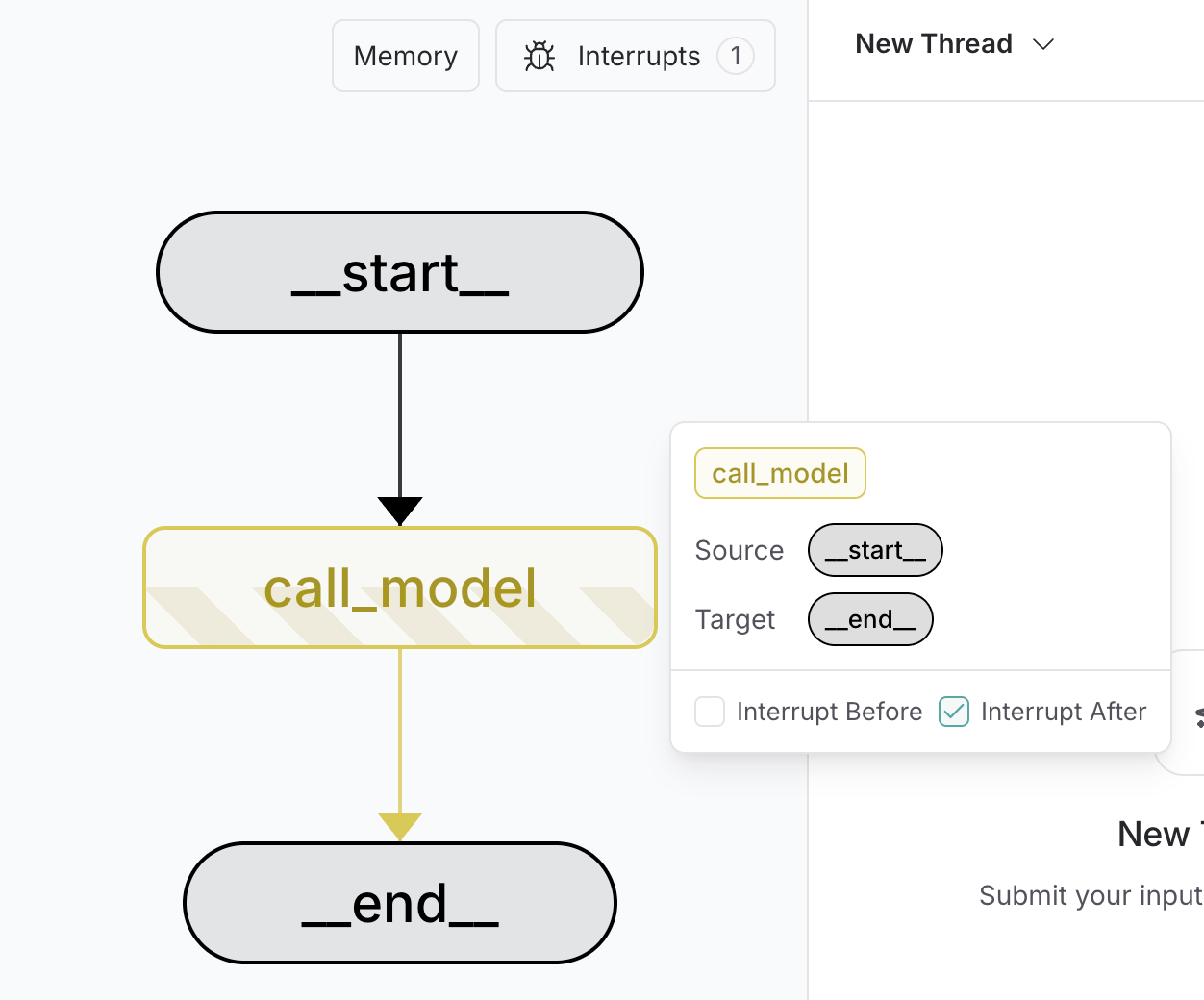
You can use [LangSmith Studio](/langsmith/studio) to set static interrupts in your graph in the UI before running the graph. You can also use the UI to inspect the graph state at any point in the execution.
 ***
***
[Connect these docs](/use-these-docs) to Claude, VSCode, and more via MCP for real-time answers.
[Edit this page on GitHub](https://github.com/langchain-ai/docs/edit/main/src/oss/langgraph/interrupts.mdx) or [file an issue](https://github.com/langchain-ai/docs/issues/new/choose).